With over 50 years of proven results, the Roux-en-Y gastric bypass sets the standard for weight loss surgery. Although newer procedures have largely replaced the Roux-Y, it still remains the preferred option for patients with severe reflux, including Barrett’s oesophagus.
What is Roux-en-Y Gastric Bypass?
The Roux-en-Y Gastric Bypass is one of three main types of bypass procedure. (The other bypass procedures are the OAGB Mini and SADI bypass). Developed in the 1970’s, The Roux-Y is the original type of bypass, with a very long track record spanning over 50 years in the treatment of obesity around the world. Because of this, newer procedures are often tested against the Roux-Y for their effectiveness.
How does Roux-en-Y Gastric Bypass Work?
As with the other types of bypass, the Roux-Y is a combined restrictive/metabolic surgical procedure. It is restrictive in the sense that it ‘restricts’ how much food the stomach can hold and is ‘metabolic’ in that it influences gut hormones, blood sugar regulation, and metabolism. This combination allows for very powerful weight control and significant improvement in metabolic problems associated with obesity such as hyperlipidaemia and diabetes.
Perhaps the key benefit of the Roux-Y over all other bariatric procedures is that it is also a highly effective treatment for Gastro-oesophageal reflux disease (GORD). If you also suffer from severe acid or bile reflux, erosive oesophagitis, or Barretts, then the Roux-Y is a weight loss procedure of choice. It can be performed either as a primary operation, or as a revision after any previous weight loss procedure.
How is the Roux-en-Y Gastric Bypass Surgery Performed?
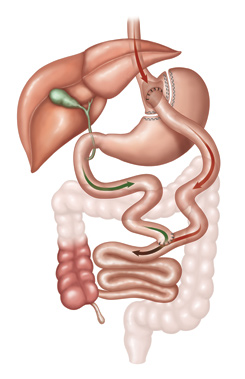
It is performed laparoscopically (keyhole surgery), using 5 small incisions. A small stomach pouch (approximately ½ a cup) is made by dividing the stomach using surgical staplers. The bottom of the pouch is then surgically joined to the small intestine. A second surgical join 100cm downstream allows digestive enzymes to enter.
The procedure takes 1-2 hours. Recovery is rapid, and you will be able to walk comfortably and drink a wide variety of fluids including coffee, juices and soup that afternoon. One night in hospital is usual, you can drive after 3 days, and return to work and everyday life after 5-7 days.
The Roux-Y gastric bypass is a highly effective weightloss procedure, with a great number of studies over 50 years reporting continued weight control at several years and beyond. It is also highly effective at treating diabetes, which will improve or resolve in most cases. And it is excellent at alleviating gastro-oesophageal reflux. It is also possible to reverse the Roux-Y if ever required.
However, as with all procedures, there are downsides. The Roux-Y carries a risk of small bowel internal hernias, which can become quite serious if they become obstructed, and require surgical correction. Dumping syndrome is also more commonly seen. There may also be a reduction in the absorption of certain micronutrients and vitamins, and therefore ongoing vitamin supplementation and monitoring are important.
Who is Eligible for Roux-en-Y Gastric Bypass?
To be considered for the Roux-Y Gastric Bypass you will need to have a Body Mass Index of at least 35. CHECK YOUR BMI
The Roux-Y bypass may be especially appropriate for you if your BMI is greater than 45, or you suffer from significant reflux or type 2 diabetes.
What are the Risks and Complications of Roux-en-Y Gastric Bypass?
As with any surgery there are potential risks involved. Whilst most patients do not have any problems after Roux-Y Bypass surgery, complications can sometimes occur, and occasionally be quite serious. Recovery and outcome may depend on the patient’s existing health status. Specific complications of the Roux-Y Bypass include:
- Short term surgical risks may affect up to 1% of patients and include leakage from staple lines or anastomoses, blood clots, bleeding and anaesthetic complications
- Long term issues include anastomotic stricture, bowel kinking, internal intestinal hernia potentially leading to obstruction, dumping syndrome, loose bowels, vitamin deficiencies, gallstones, and marginal ulcers (ulcer forming on the anastomosis)
Come in for your consultation where we will discuss the Roux-Y bypass in more detail including benefits and risks.
If you wish to be advised on the most appropriate treatment, please call to schedule an appointment or click to request an appointment online.